 blog
What Is the Best Underlayment for Solid Hardwood Floors?
Last Updated: October 28, 2026
Quick Summary
The best underlayment for solid hardwood depends on the installation method, not a single product. Nail-down solid hardwood over plywood or OSB uses thin felt or rosin paper as a separator, while glue-down over concrete relies on the adhesive system and a tested vapor retarder. Test the subfloor moisture first, then match the material to your situation.
- Nail-down solid hardwood over wood uses thin felt or rosin paper as a slip sheet, not a cushion.
- Felt is typically specified at 15 lb or 30 lb per 100 square feet; rosin paper is lighter.
- Overlap felt seams by roughly 4 to 6 inches and tape or staple them flat.
- Test concrete with ASTM F1869 or ASTM F2170 before opening any adhesive.
- Solid hardwood is rarely floated; confirm the method in the manufacturer's installation guide.
Table of Contents
- Underlayment for Nail-Down Hardwood Floors vs. Floating Installations
- Felt, Foam, Cork, and Rubber Underlayment Compared
- Underlayment for Floating Hardwood Floors: What Changes
- Hardwood Floor Moisture Barrier: Testing, Thresholds, and Vapor Protection
- Soundproof Underlayment for Hardwood Flooring and Noise Control
- Choosing Your Underlayment Before Scheduling Installation
- Frequently Asked Questions
Choosing the best underlayment for solid hardwood floors affects how quiet, stable, and long-lasting your floor will be.
Solid hardwood is more sensitive to moisture than engineered flooring. Wood expands and contracts with humidity, causing gaps, cupping, and crowning.
A common mistake is assuming all underlayment does the same job. Some products prioritize sound reduction, others vapor control, and a few do both.
Underlayment for Nail-Down Hardwood Floors vs. Floating Installations
The most important underlayment decision for solid hardwood is not which material to buy, it is whether you need a separate underlayment layer at all. That answer comes from the installation method: solid hardwood is almost always nail-down over a wood subfloor or glue-down over a properly prepared slab. Floating is rare because solid boards are too dimensionally active to lock together reliably.
Nail-Down Solid Hardwood
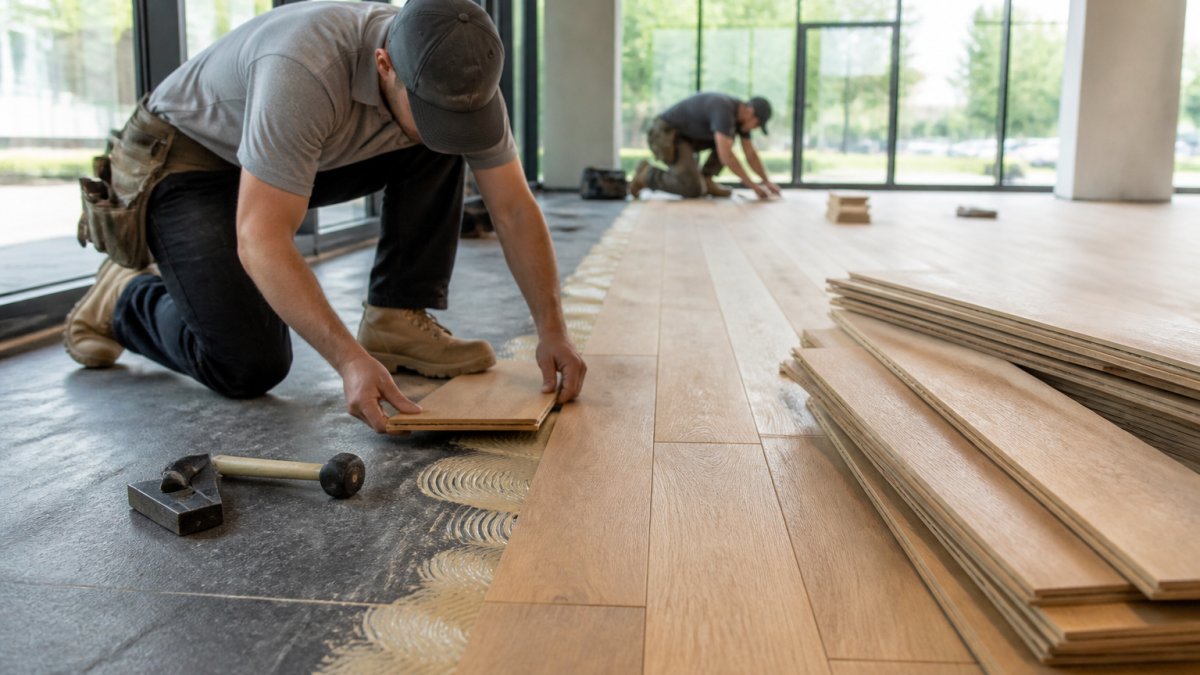
In a nail-down assembly, cleats or staples pass through the tongue of each board into the wood subfloor. The underlayment here is not a cushion, it is a separator and slip sheet. Its jobs are to:
- Keep the board from bonding to the subfloor so the wood can move independently as humidity changes.
- Slow moisture vapor movement without sealing the assembly.
- Reduce friction squeaks where board meets subfloor.
- Provide a clean, dust-free surface so fasteners seat consistently.
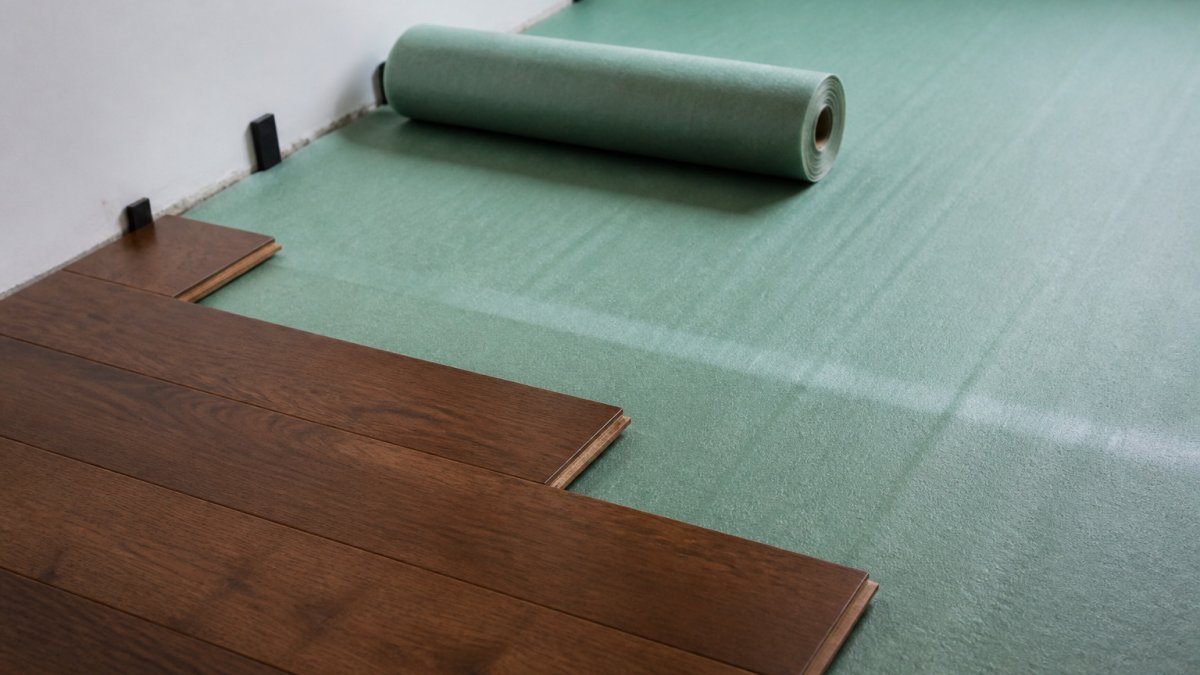
For nail-down solid hardwood over plywood or OSB, the standard underlayment is thin asphalt-saturated felt (builder's felt or tar paper) or rosin paper. Felt is typically specified at 15 lb or 30 lb per 100 square feet; rosin paper is lighter and less moisture-resistant. Neither is a vapor barrier, and neither is meant to be, the assembly needs to breathe so the wood can reach equilibrium.
Installation details that matter:
- Roll the felt perpendicular to the floor joists so seams do not line up with board ends.
- Overlap seams by roughly 4 to 6 inches and tape or staple them flat.
- Do not leave bare subfloor patches, dust and debris create high spots that telegraph through the finished floor.
- Do not double-layer felt to "add protection." Extra thickness changes fastener holding and can void the warranty.
Glue-Down Solid Hardwood
Glue-down installations over concrete do not use a traditional felt or foam underlayment. The adhesive bonds the board to the slab, and moisture control comes from the adhesive system plus a vapor retarder or epoxy moisture barrier specified by the adhesive manufacturer. Adding a cushion layer between slab and adhesive can compromise bond strength.
For glue-down work, the priorities shift to:
- Slab moisture testing before any adhesive is opened (see the moisture section below).
- A manufacturer-approved vapor retarder or moisture-mitigation coating when test results exceed the adhesive's limit.
- Adhesive open time and trowel size matched to the board width and job-site conditions.
Floating Is Not the Solid Hardwood Default
Floating floors, planks that click together and rest on a pad, are common for engineered and laminate products, not solid hardwood. Solid boards move too much with humidity for most locking systems, and most solid hardwood warranties assume nail-down or glue-down. If you have been told your solid hardwood can float, confirm it in the manufacturer's installation guide. If it cannot, the underlayment question is settled: it is a nail-down or glue-down decision.
Felt, Foam, Cork, and Rubber Underlayment Compared
Each common underlayment type has clear strengths and limits. The right pick depends on the installation method and what you need the layer to do.
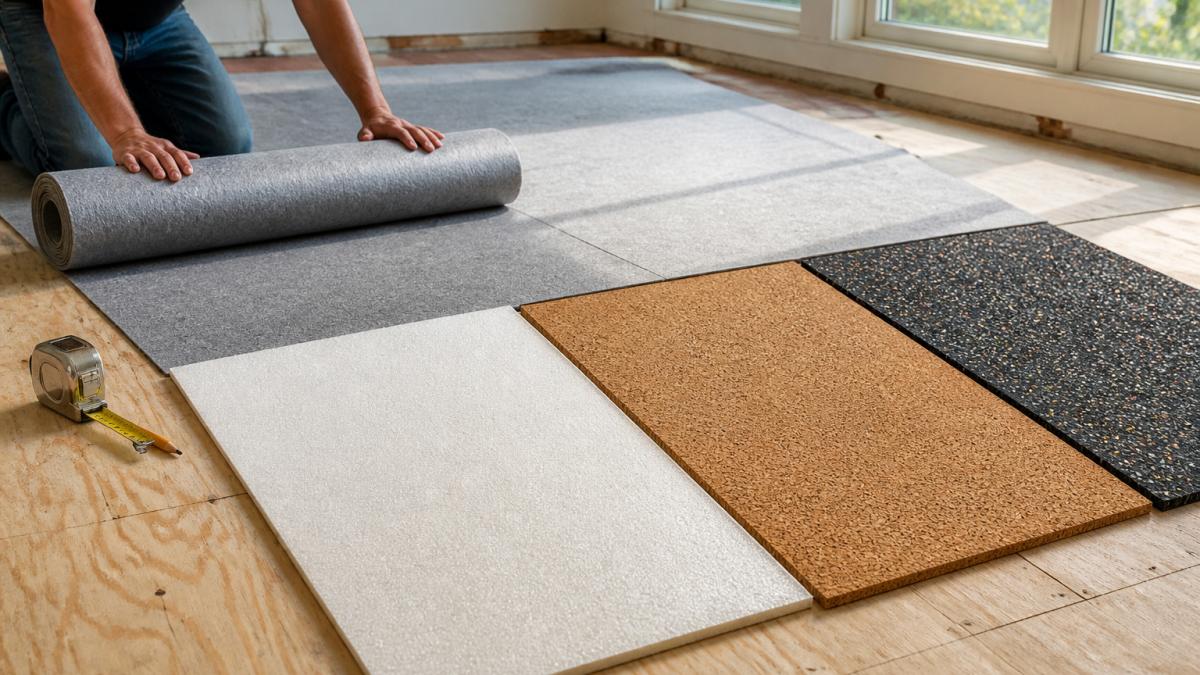
| Underlayment | Main Strength | Main Limit | Typical Use |
|---|---|---|---|
| Felt or rosin paper | Low cost, easy to install, separates wood from subfloor | Minimal cushioning or sound control | Nail-down solid hardwood |
| Foam (2 mm and up) | Good footfall cushioning and some sound reduction | Can trap moisture if the slab is wet | Floating floors and some engineered products |
| Cork | Natural cushioning, good sound absorption, some moisture resistance | Costs more, can compress over time | Quiet rooms and upper floors |
| Rubber | Strong sound reduction and durability | Heavier, higher cost, can be harder to cut | Multifamily buildings and noise-sensitive spaces |
Felt and Rosin Paper Underlayment
Felt and rosin paper are the most common choices for nail-down solid hardwood over plywood or OSB. They are breathable, allowing moisture to move rather than trapping it, and give fasteners a clean surface. Rosin paper is slightly more moisture-resistant than standard felt, but neither is a true vapor barrier. Installers unroll felt perpendicular to the joists, overlap seams by several inches, and tape them down, avoiding bare spots where dust and debris create high spots.
Foam, Cork, and Rubber Underlayment
Foam, cork, and rubber are cushioned options aimed at comfort and noise control. Foam is most widely used for floating floors, often from 2 mm up. Cork offers natural sound absorption and a soft feel underfoot. Rubber provides the strongest impact noise reduction, which is why it appears in apartments and commercial spaces. The tradeoff is moisture: dense foam and rubber can block vapor movement, a problem over damp concrete. Confirm the product is rated for your subfloor and the manufacturer's requirements before purchase.
Underlayment for Floating Hardwood Floors: What Changes
Floating solid or engineered floors behave differently from nail-down boards. Because they are not fastened to the subfloor, they rely on the pad to absorb movement and provide a level, slightly resilient base.
Many homeowners search for "underlayment for floating hardwood floors" when a floor starts to click or sink. The cause is usually an underlayment that is too thick, too compressed, or not designed for the load; a manufacturer-approved replacement usually solves the problem.
Hardwood Floor Moisture Barrier: Testing, Thresholds, and Vapor Protection
Moisture is the biggest threat to solid hardwood, and the underlayment decision is downstream of the moisture test. Here is what to test, what the numbers mean, and how results drive the choice between a vapor retarder, a vapor barrier, and no added layer.
Test the Subfloor Before You Buy Anything
Concrete slabs. Two field methods are standard:
- Calcium chloride test (ASTM F1869). Measures moisture vapor emission rate (MVER) in pounds per 1,000 square feet per 24 hours. Results are reported as a number like "3 lb" or "5 lb."
- In-situ relative humidity probe (ASTM F2170). Measures the relative humidity inside the slab at a specified depth. Results are reported as a percentage, such as "75% RH" or "85% RH."
Both tests require the slab at service conditions, HVAC running, finished grade, and at least 30 days of cure for new concrete. Testing a slab that is still drying or unconditioned produces numbers that do not reflect the finished floor's environment.
Wood subfloors. Use a pin or pinless moisture meter on plywood or OSB. Take multiple readings across the room, especially near exterior walls, plumbing penetrations, and crawlspace access.
What the Numbers Mean
There is no universal pass/fail number for every solid hardwood product. Acceptable thresholds are set by the flooring manufacturer and, for glue-down work, the adhesive manufacturer. Common industry patterns:
- Many solid hardwood manufacturers publish a maximum subfloor moisture content for wood subfloors, often 12% to 14%, with the flooring acclimated to within a few percentage points of the subfloor.
- Adhesive manufacturers commonly publish MVER limits around 3 to 5 lb per ASTM F1869, or RH limits around 75% to 80% per ASTM F2170, depending on the adhesive chemistry.
- When results exceed the adhesive's limit, the fix is a manufacturer-approved moisture-mitigation coating or vapor retarder, not a thicker underlayment pad.
Vapor Retarder vs. Vapor Barrier vs. Slip Sheet
These three terms get used interchangeably in marketing copy but describe different functions:
- Slip sheet. Separates the wood from the subfloor and allows movement. Felt and rosin paper act as slip sheets. They are not vapor barriers.
- Vapor retarder. Slows moisture vapor movement but is not fully impermeable. Some sheet goods and coatings fall here.
- Vapor barrier. Intended to block vapor movement almost entirely. Impermeable membranes and some epoxy coatings fall here.
For nail-down solid hardwood over a wood subfloor, the felt or rosin paper is a slip sheet, not a vapor barrier, and that is correct for the assembly. For glue-down over concrete, the vapor retarder or barrier is specified by the adhesive manufacturer and installed as part of the adhesive system.
Wood Moisture Content and Acclimation
The U.S. Forest Products Laboratory, part of the USDA Forest Service, documents that wood moisture content equilibrates with the surrounding air, which is why acclimation matters as much as the underlayment choice. Practical steps:
- Acclimate the flooring in the room where it will be installed, in the packaging configuration and for the time the manufacturer specifies.
- Keep HVAC running at normal occupied conditions during acclimation and installation.
- Verify with a moisture meter that the flooring and subfloor are close to equilibrium before installation begins.
- If the subfloor is wet, fix the source, a leak, poor drainage, or crawlspace humidity, before any underlayment or flooring goes down. No underlayment product fixes a wet subfloor.
Soundproof Underlayment for Hardwood Flooring and Noise Control
If noise is the main concern, look for underlayment rated for impact sound reduction, often measured by an Impact Insulation Class (IIC) rating. Higher ratings mean better performance against footfall and dropped objects; rubber and dense cork typically perform best, while thin felt provides little acoustic benefit. Sound control is a system, though, the underlayment, subfloor, joist spacing, and ceiling below all affect how much noise travels. In multifamily buildings, local codes and the building's own requirements may set minimum ratings, so check those before buying.
Choosing Your Underlayment Before Scheduling Installation
Settling the underlayment before installation day prevents costly delays. Work through this sequence:
- Confirm the installation method: nail-down, floating, or glue-down.
- Identify the subfloor type: plywood, OSB, or concrete slab.
- Test the subfloor moisture and note the results.
- Choose the underlayment that matches the method, moisture reading, and sound goals.
- Check the flooring manufacturer's approved underlayment list.
- Confirm the finished floor height and how it meets doors, thresholds, and transitions.
Freddie Sanchez Hardwood Floors specializes in wood floor installation and prioritizes clear communication throughout the project. Request a free quote to get started.
Frequently Asked Questions
Do solid hardwood floors need underlayment?
Solid hardwood installations may use different underlayment approaches depending on the installation method and subfloor. Follow the hardwood manufacturer's installation instructions.
Can you use foam underlayment under solid hardwood?
Whether foam underlayment is suitable depends on the flooring product and installation instructions. Check the flooring manufacturer's installation guide.
What is the recommended underlayment thickness for hardwood floors?
The correct underlayment thickness depends on the flooring product and installation instructions. Confirm the requirement in the manufacturer's installation guide before purchasing material.
Does solid hardwood flooring need a moisture barrier?
Whether a moisture barrier or vapor retarder is appropriate depends on the flooring product, installation method, and subfloor. Follow the flooring manufacturer's installation instructions.