 how-to
How Long Does Hardwood Floor Installation Take? 7 Timeline Factors
Last Updated: November 1, 2026
Quick Summary
Hardwood floor installation usually takes 1 to 3 active labor days per 500 square feet, but total calendar time runs longer once acclimation and finish curing are counted. Expect roughly 3 to 7 days for prefinished floors and 8 to 17 days for unfinished floors finished on site.
- Plan furniture storage and move-out around calendar days, not labor days.
- Acclimation typically runs 2 to 7 days depending on wood type and method.
- Unfinished floors add 2 to 3 days of sanding and finishing after install.
- Light foot traffic is often safe within a day or two, but furniture waits for full cure.
- Ask your installer for labor-day and calendar-day counts separately in the estimate.
Table of Contents
- Hardwood Floor Installation Timeline: Labor Days vs. Calendar Time
- Active Labor Time vs. Total Project Duration
- Hardwood Floor Installation Time Per Square Foot
- Hardwood Floor Acclimation Time Before Installation
- Timeline by Flooring Type and Installation Method
- Sanding, Staining, and Finishing: The Days After Planks Go Down
- Subfloor Prep, Demolition, and Delays That Stretch the Schedule
- When Can You Walk on Newly Installed Hardwood Floors?
- Get a Free Quote and a Realistic Schedule for Your Floors
- Frequently Asked Questions
Hardwood Floor Installation Timeline: Labor Days vs. Calendar Time
Most homeowners ask how long does hardwood floor installation take and expect one number. The honest answer is two numbers: the days a crew actually works, and the days you lose your room. This guide breaks down both, so you can plan around a realistic schedule.
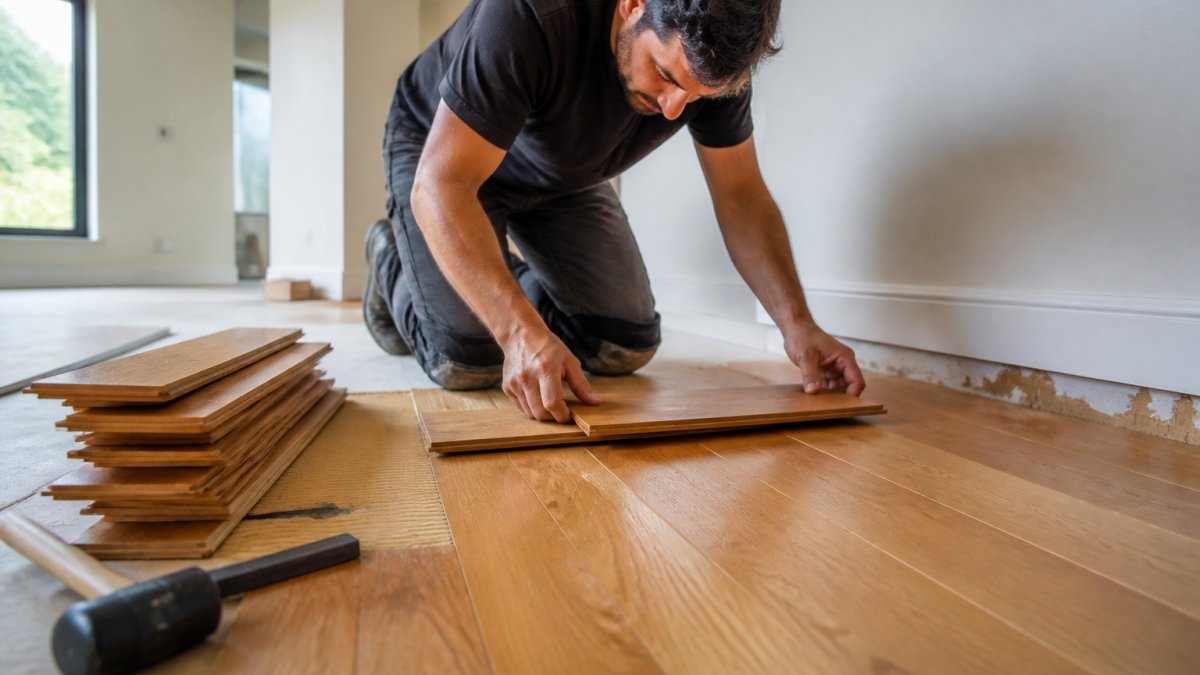
Hardwood floor installation is the process of preparing a subfloor, laying wood planks, and finishing the surface so the floor is ready for daily use. The work itself is only part of the clock. Acclimation, drying, and curing eat calendar days without anyone swinging a hammer.
Here is the distinction that changes your planning:
- Labor time: active work hours, usually a few days for an average room
- Calendar time: labor plus acclimation, demolition, and finish curing
- Walk-on time: when foot traffic is safe, which comes before furniture goes back
Below, we walk through each stage so you can build a realistic schedule.
Active Labor Time vs. Total Project Duration
Active labor and total project duration are not the same thing, and mixing them up is the most common planning mistake we see.
The wood may need to sit in the house for days before it is laid. Finish needs time to cure after that. The room stays off-limits through all of it.
Think of it this way:
- Labor days: the crew is on site, cutting and nailing
- Wait days: wood acclimates, finish dries, nothing visible happens
- Buffer days: surprises like a soft subfloor or a stuck transition
Plan your move-out and furniture storage around calendar days, not labor days. That single shift prevents most scheduling conflicts with your contractor.
Hardwood Floor Installation Time Per Square Foot
Hardwood floor installation time per square foot depends on the method, the room layout, and how much prep the subfloor needs.
Complex cuts around doorways, closets, and angles slow things down. So does furniture that has to be moved first.
Here is how the work tends to break down:
- Open, square rooms: fastest pace, few cuts
- Rooms with many doorways: slower, more transitions and trim work
- Diagonal or herringbone layouts: slowest, lots of angled cuts
- Upper floors: extra time hauling materials and old flooring
Square footage matters, but layout matters more. A small room with four doorways can take as long as a larger open room.
Hardwood Floor Acclimation Time Before Installation
Hardwood floor acclimation time is the waiting period that lets wood adjust to your home's temperature and humidity before it goes down. Skip it, and planks can gap or cup after installation.
Wood expands and contracts with moisture (Measurement and practical application of tangential dimensional change coefficients to...). Letting it settle into the house first generally reduces movement after installation.
What affects acclimation length:
- Wood species and thickness: denser, thicker planks often need more time
- Indoor humidity and temperature: stable conditions speed the process
- Storage method: planks stacked with spacers acclimate more evenly
- Time of year: humid summers and dry winters change the timeline
Acclimation is typically done by bringing the wood inside ahead of installation so it can settle in the room. Moisture content should be checked before work begins. Ask about this step up front, because it is where rushed jobs go wrong.
Timeline by Flooring Type and Installation Method
Timeline estimates shift with flooring type and installation method, so treat any single number with suspicion. The table below separates active labor days from total calendar days, the two numbers that actually determine when you get your room back. Ranges reflect typical residential projects; your crew's pace and your subfloor will move them.
| Flooring type / method | Active labor (per 500 sq ft) | Acclimation | Finish / cure wait | Total calendar time |
|---|---|---|---|---|
| Prefinished solid, nail-down | 1-2 days | 3-5 days | None (factory finish) | 4-7 days |
| Prefinished engineered, floating | 1 day | 2-3 days | None | 3-4 days |
| Prefinished engineered, glue-down | 1-2 days | 2-3 days | 24-48 hrs glue cure before heavy traffic | 4-6 days |
| Unfinished solid, nail-down + site finish | 2-3 days install + 2-3 days sand/finish | 5-7 days | 3-7 days cure before furniture | 10-17 days |
| Unfinished engineered, glue-down + site finish | 2-3 days install + 2-3 days sand/finish | 3-5 days | 3-7 days cure | 8-15 days |
How to read the table:
- Prefinished floors arrive sanded and sealed, so the room is usable as soon as the last plank is set and any glue has cured.
- Unfinished floors add a second phase, sanding, staining, and sealing on site, and each coat needs its own drying window. The finish, not the planks, is usually what keeps you out of the room.
- Solid vs. engineered changes acclimation more than install speed. Solid wood moves more with humidity and generally wants the longer sit time; engineered planks are dimensionally more stable and often acclimate faster.
- Nail-down vs. glue-down vs. floating changes the per-plank pace and the cure step. Floating is fastest to lay but needs a flat substrate; glue-down is slower per plank and adds a glue-cure window; nail-down is the standard steady pace over wood subfloors.
The method chosen should match the subfloor first, then the schedule.
Sanding, Staining, and Finishing: The Days After Planks Go Down
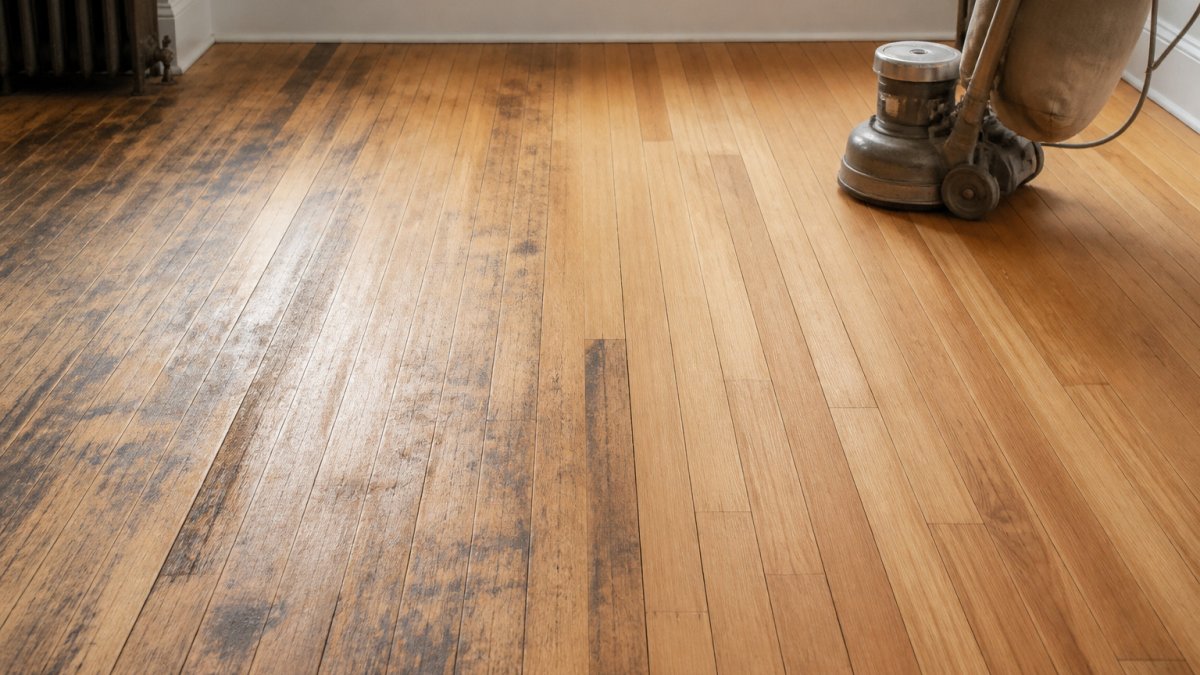
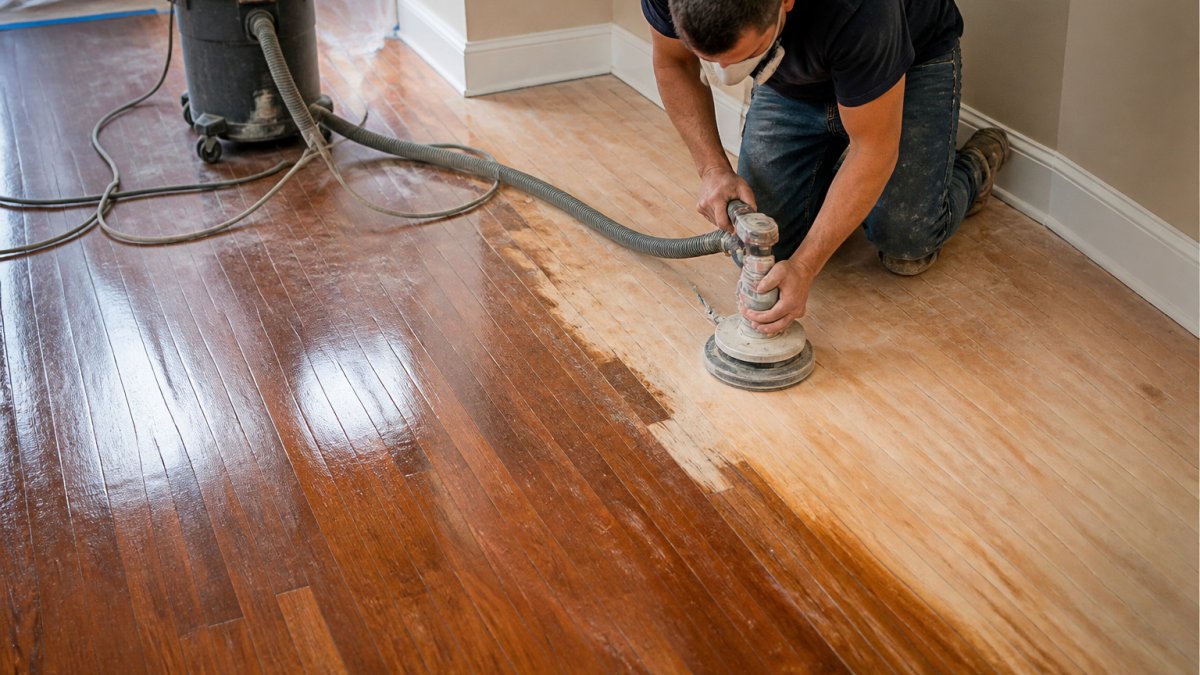
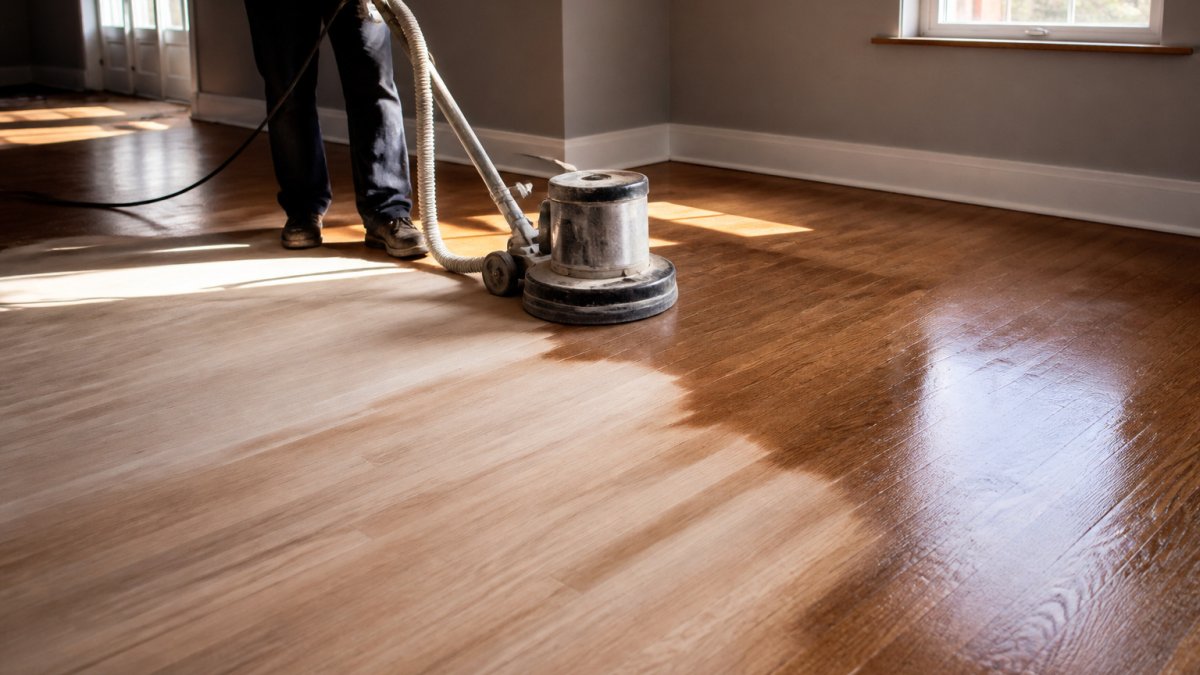
Sanding, staining, and finishing add days after the planks are down, and this stage is where unfinished wood projects stretch out.
Unfinished wood gets sanded smooth, stained to your chosen color, then sealed with a finish. Each coat needs drying time between passes. Rushing coats leads to a cloudy or uneven surface.
The sequence usually looks like this:
- Sand the floor smooth through several grits
- Clean all dust from the surface
- Apply stain and let it dry
- Apply finish coats with drying time between each
- Let the final coat cure before heavy use
Ventilation and humidity affect drying time.
Subfloor Prep, Demolition, and Delays That Stretch the Schedule
Subfloor prep and demolition are the two stages most likely to blow up a schedule, and they are the hardest to predict before work starts. The reason is simple: nobody knows what is under the old floor until it comes up. Plan for a contingency window rather than a single date.
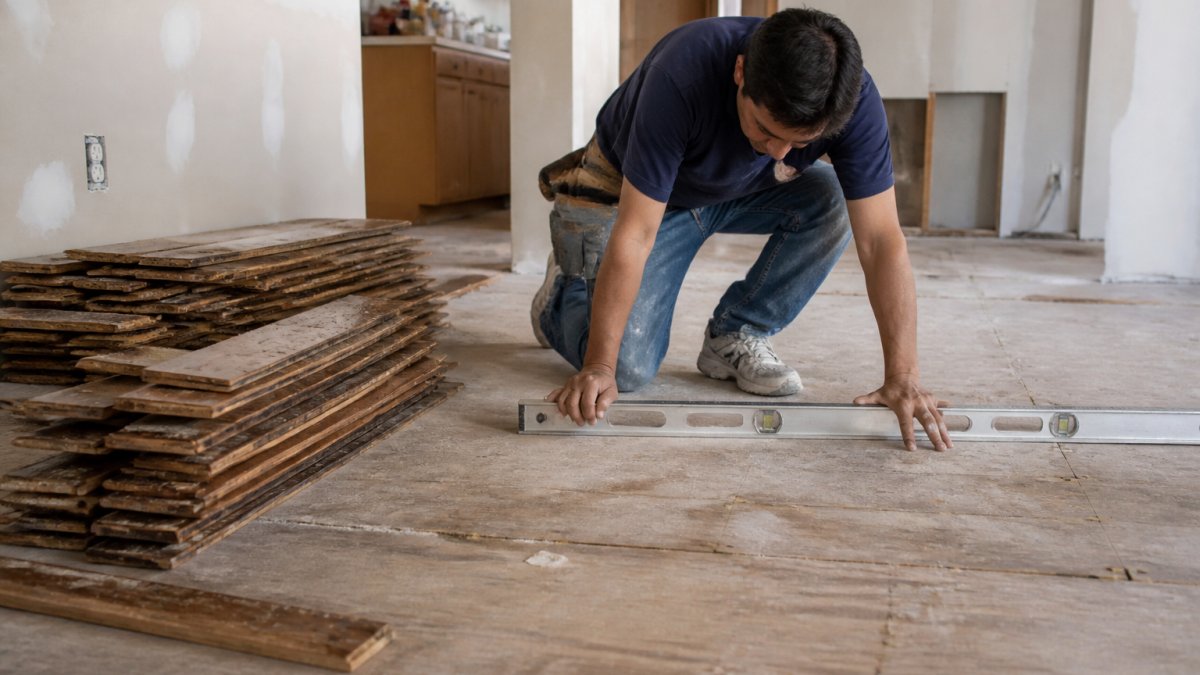
Demolition time. Removing existing flooring can take varying amounts of time depending on the material. Ask whether demolition and haul-away are included in any quote you receive.
Subfloor condition. Once the old floor is up, the substrate gets checked for three things:
- Flatness. Most wood flooring manufacturers publish a flatness tolerance (commonly 3/16 inch over 10 feet, though it varies by product). Low spots get filled, high spots get sanded or ground. A floor that is out of tolerance will telegraph through planks and cause squeaks or gaps.
- Moisture. A moisture test on the subfloor (and on concrete slabs, a calcium chloride or in-situ probe test) tells the installer whether the substrate is dry enough for wood. Wet subfloors must dry before planks go down. Skipping this step to save a day is how floors cup and gap months later.
- Structural soundness. Soft, delaminated, or water-damaged sections get cut out and replaced. Rot or old water stains found under the flooring are a common surprise in older homes.
Common delay triggers, ranked by how often they push a schedule:
- Moisture found under the old floor, adds dry-out time before install can start
- Out-of-tolerance subfloor, adds leveling or grinding days
- Glued or tiled old flooring, adds demolition time
- Hidden rot or soft spots, adds repair and sometimes a framing fix
- Transition and trim surprises, door undercuts, stair noses, and threshold changes that were not in the original scope
A slow start beats a failed floor. Build the buffer into the calendar, not into wishful thinking.
When Can You Walk on Newly Installed Hardwood Floors?
When can you walk on newly installed hardwood floors? Usually once the finish is dry enough to take light foot traffic, which is often within a day or two, but full cure takes longer.
Walking and moving furniture are two different thresholds. Light foot traffic comes first. Heavy furniture and rugs should wait until the finish fully cures, which can take several days to a week or more depending on the product.
Practical rules:
- Light foot traffic: socks only, no shoes, once dry
- Furniture: wait for full cure, use felt pads
- Rugs: hold off until cure is complete
- Mopping: wait, and keep water minimal
Ask your installer for the exact walk-on and furniture timeline for the finish used. It varies by product.
Get a Free Quote and a Realistic Schedule for Your Floors
Getting an accurate schedule starts with an on-site look at your subfloor, your layout, and your flooring choice. No phone estimate can predict a soft subfloor or a tricky transition.
At Freddie Sanchez Hardwood Floors, we build the timeline around your project, not a generic average. Our team provides expert wood floor installation with high standards of craftsmanship and durability. We also keep constant communication with you until the job is done, so you always know what happens next.
Want a realistic schedule instead of a guess? Get a free quote from Freddie Sanchez Hardwood Floors and plan your project with confidence.
Frequently Asked Questions
How long does it take to install hardwood floors in one room?
Active labor time depends on the room and the layout. Add the acclimation period, plus sanding and finishing time if you choose unfinished wood. Small rooms with simple layouts generally move faster, while rooms with many doorways, closets, and complex cuts take longer.
Does prefinished hardwood take less time to install than unfinished hardwood?
Yes. Prefinished hardwood installation time is shorter because the planks arrive sanded, stained, and sealed at the factory. There is no on-site sanding, staining, or finish curing, so a room that might take several extra days with unfinished wood can be completed in a fraction of that time. For sellers on a tight schedule, prefinished is often the faster path.
What can delay a hardwood floor installation?
Common delays include subfloor problems, removal of existing flooring, and weather and humidity affecting acclimation and finish curing. Material availability can also push the start date.
How long after hardwood floor installation can you walk on it?
Walk-on and furniture timelines depend on the finish used. Check with your installer for the exact schedule for your floor. Keep heavy items off the floor and maintain steady humidity until the finish has fully cured.